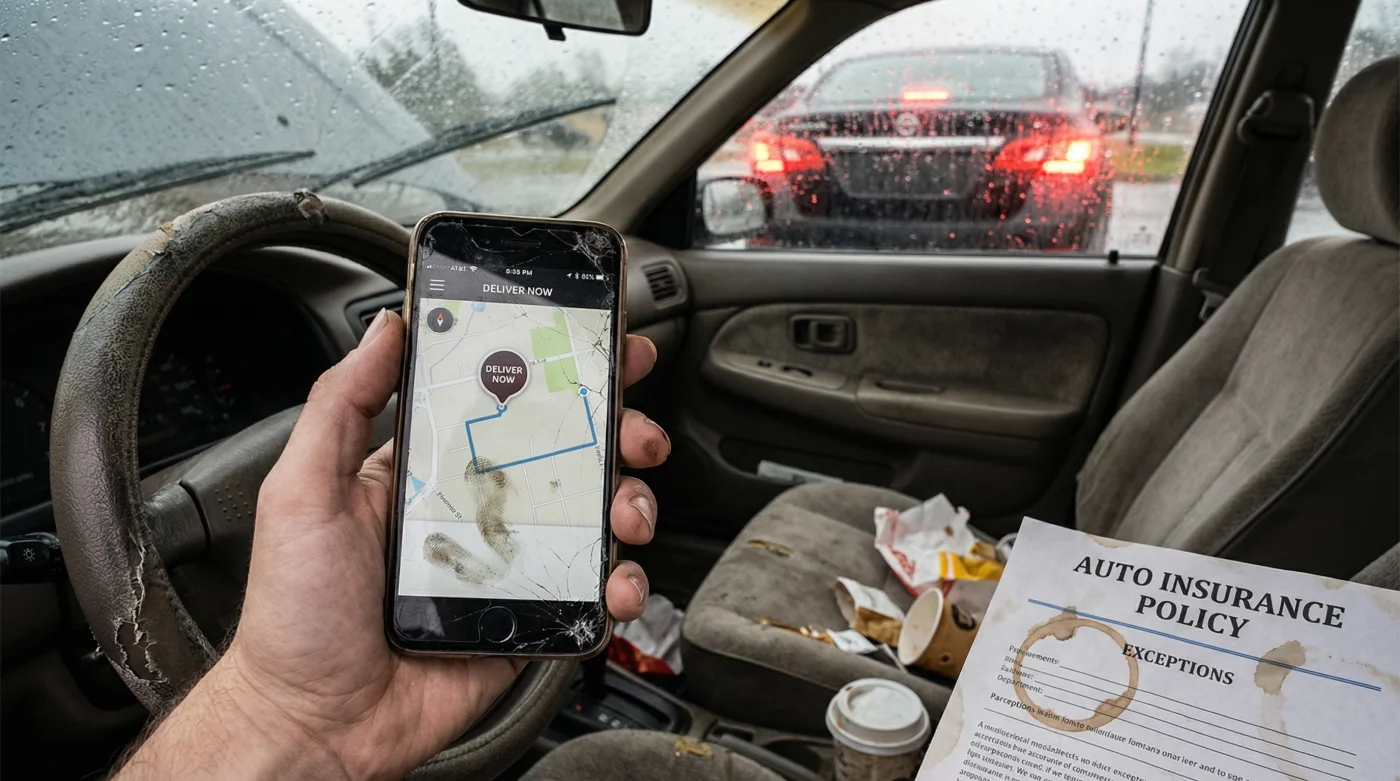
The night air smells faintly of cold french fries and the sharp, chemical tang of deployed airbags. You sit on the shoulder of the interstate, your hazard lights pulsing a steady, rhythmic orange against the guardrail. Your heart beats heavily in your throat, but as the adrenaline slowly recedes, a comforting thought washes over you: I have full coverage. You pay your premium on time every single month. You are safe. You are protected. Except, three weeks later, you open a thin white envelope from your provider and find your claim completely denied. Your car is totaled, and you are entirely on the hook.
Why? Because of a single bag of food sitting in your passenger seat.
The Illusion of the Iron Shield
We are conditioned to believe that ‘full coverage’ is an iron shield. We assume it wraps around the vehicle, protecting us from every errant swerve, icy patch, or distracted driver we encounter. But car insurance is not an iron shield. It is a tailored suit. If you stretch that fabric doing physical movements it was never sewn to accommodate, the seams rip apart exactly when you need them to hold.
The contradiction that catches thousands of drivers off guard every year is the assumption that personal auto policies protect you regardless of your destination. The reality is far more rigid. The moment you log into a gig economy app—whether you are ferrying passengers across town or delivering a late-night burrito—you trigger a silent trapdoor in your contract known as the business use exclusion clause.
| Driver Profile | The Specific Benefit of Checking Your Clause |
|---|---|
| Rideshare Drivers | Prevents absolute financial ruin in the event of passenger-injury lawsuits. |
| Food & Grocery Couriers | Ensures your personal vehicle repair costs are not denied due to unlisted commercial use. |
| Standard Commuters | Provides the quiet confidence that your daily routine remains fully protected under standard terms. |
Let me tell you about Marcus, a veteran claims adjuster I met in a brightly lit, low-ceilinged office in Ohio. His desk was buried under stacks of manila folders, and he drank bitter office coffee from a chipped mug. He held up a thick contract and dragged a yellow highlighter over one line of microscopic text. “Here it is,” he said, tapping the page. “The business use exclusion. People think delivering food is just running an errand. To the insurance company, the second that app goes online, you are operating an unregulated commercial enterprise.”
Marcus explained that adjusting claims has become a heartbreaking process in the gig economy era. Drivers faithfully pay their personal premiums, unaware that their coverage instantly evaporates the moment they accept a fare.
| Driving Phase | App Status | Who Actually Covers You? |
|---|---|---|
| Phase 1: Personal | App is completely turned off. | Your personal policy (Full coverage applies). |
| Phase 2: The Gray Zone | App is on, waiting for a request. | Personal policy is voided. Gig platform provides only bare-minimum liability. You have no collision coverage. |
| Phase 3: Engaged | En route to pickup or drop-off. | Gig platform commercial policy kicks in (Often with massive $2,500 deductibles). |
Mending the Gap Before You Drive
Fixing this vulnerability requires mindful, immediate action. You cannot wait until the tow truck arrives to figure out your coverage limits.
First, pick up the phone and call your insurance agent. Tell them exactly how you use your car. Honesty is your only defense here. Ask them directly to add a rideshare or delivery endorsement to your existing personal policy.
- Air fryer basket non-stick coatings peel away using aerosol cooking sprays.
- Lithium-ion drill battery lifespans plummet when stored inside hot garages.
- Car insurance policy holders lose accident claims ignoring this specific clause.
- Baking soda destroys washing machine seals over extended regular use.
- Tire pressure sensor lights trigger false alerts during sudden temperature drops.
When reviewing your options, carefully evaluate the deductible structures. The commercial coverage provided by gig apps often carries deductibles as high as $2,500. A proper personal endorsement can lower your out-of-pocket expenses to match your standard personal deductible.
| Quality Checklist | What to Look For | What to Avoid |
|---|---|---|
| Policy Wording | Explicit mention of ‘Rideshare’ or ‘Transportation Network’ endorsements. | Assuming ‘Comprehensive’ means ‘Commercial’. It does not. |
| Gap Protection | Coverage that specifically protects you during ‘Phase 2’ (App on, waiting). | Silent policies that refuse to acknowledge gig economy work entirely. |
| Deductible Match | An endorsement that keeps your collision deductible at a manageable $500. | Relying solely on the gig platform’s default, high-deductible safety net. |
Driving with True Clarity
Taking control of your insurance policy changes the physical sensation of driving. You no longer grip the steering wheel with an underlying, subconscious tension. When you know your tailored suit fits perfectly, you can move freely.
Securing a rideshare or delivery endorsement is not just about fulfilling a bureaucratic requirement. It is about honoring the time, energy, and money you invest into your vehicle. You work hard to earn an income behind the wheel; do not let a hidden clause strip away everything you have built.
When you turn the key in the ignition, you should hear the steady hum of an engine, not the ticking clock of a liability waiting to happen. Fix your coverage today, and drive with the profound peace of mind you truly deserve.
“A policy only protects the version of you it was specifically written for; make sure your provider knows exactly who is sitting behind the wheel.” — Marcus T., Senior Claims Adjuster
Frequently Asked Questions
Does delivering for food apps really count as commercial driving?
Yes. The moment you are paid to transport goods or people, your insurance company classifies it as business use, instantly voiding personal coverage.Will my insurance drop me if I tell them I drive for a gig app?
Most major providers today offer specific gig-economy endorsements. Lying to them is much riskier, as it constitutes insurance fraud and guarantees a denied claim.How much does a rideshare endorsement usually cost?
It varies by region and provider, but it typically adds only $10 to $20 to your monthly premium—a tiny price compared to a denied $15,000 totaled car claim.Does the gig app’s insurance protect me if I hit someone?
Gig apps provide liability coverage for the other person if you are at fault, but their collision deductibles for your car are notoriously high, often leaving you responsible for thousands.Can I just turn the app off quickly if I get into an accident?
No. Claims adjusters routinely subpoena digital logs from gig platforms during accident investigations. The digital footprint will reveal your status at the exact moment of impact.