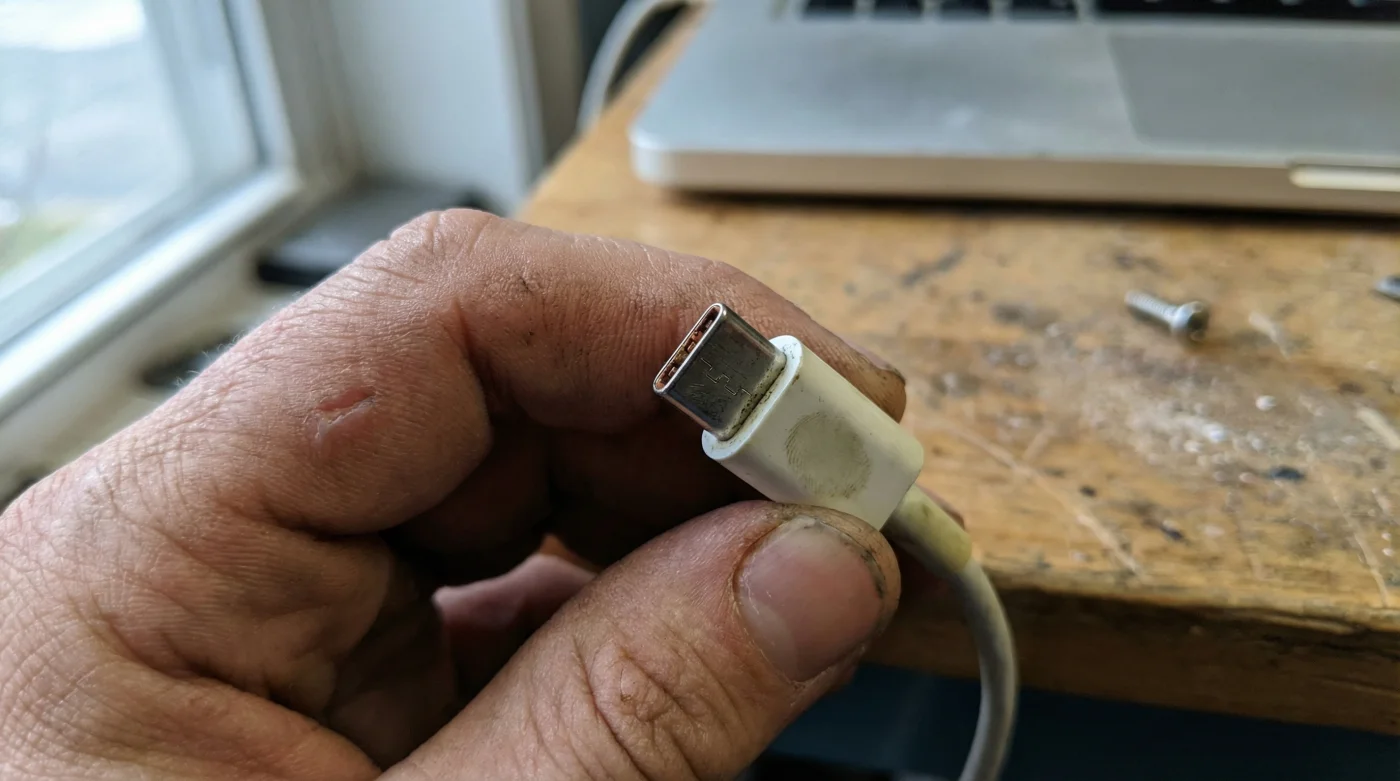
You know the smell before you see the smoke. It is that sharp, metallic scent of burnt ozone, subtle but undeniable, wafting from the side of your keyboard. A moment ago, you were just topping off your battery at a local coffee shop. You had grabbed a spare cord from a gas station discount bin during a road trip because it looked rugged enough. It fit perfectly into the port with a reassuring physical click. But beneath that sleek, braided jacket, a quiet, catastrophic electrical failure was already in motion. Your screen flickers, goes black, and suddenly your premium work machine turns into a very heavy, very expensive aluminum paperweight.
We assume a plug is just a plug. If the metal fits the slot, we trust the connection. But the cords powering our modern devices are no longer just dumb copper wires transferring power from the wall. They are active participants in a high-stakes negotiation. When you plug a cheap, non-compliant cord into your laptop, you bypass a critical safety measure, allowing a raw surge of electricity to rush into delicate components that were never built to handle the flood.
The High-Voltage Floodgate
Think of your charging port as a heavy traffic drawbridge. Before the cars can cross, the bridge operator needs to confirm the weight limit. If the bridge fails to ask, and a fleet of heavy freight trucks rolls across, the structure collapses under the strain. In the electronic world, that bridge operator is a tiny component known as a 56k Ohm pull-up resistor. Its sole job is to tell the power source exactly how much current your device can safely swallow.
I learned this the hard way while standing at the counter of an independent repair shop in Austin, Texas. Marcus, a veteran technician with soldering burns mapping his fingertips, slid a cracked logic board across the glass case. He pointed to a charred black spot near the charging port. “People think the magic happens in the brick,” he said, shaking his head. “But the cord is the throttle. Without the right resistor, the power source assumes you plugged in a massive, high-draw device. It opens the floodgates, pushes three amps straight into a circuit built for one, and fries the board instantly.”
| Device User Profile | Common Charging Habit | Benefit of a 56k Ohm Cable |
|---|---|---|
| The Commuter | Plugging into random airport terminals and rental cars. | Prevents foreign power surges from destroying the battery controller. |
| The Creative Professional | Using hubs to connect monitors, drives, and power simultaneously. | Ensures consistent data integrity while managing heavy power loads. |
| The Casual User | Buying multi-packs of cheap cords for every room. | Guarantees baseline safety across older and newer wall adapters. |
Anatomy of a Quiet Disaster
The danger hides in the transition between older, large rectangular plugs and the newer, reversible standard. The older ports max out at a relatively harmless level of power. The newer standard can handle enough wattage to run a massive display. When you use a cord that bridges an old wall charger to your modern laptop, the cord itself must act as the translator. If the manufacturer skipped the 56k Ohm resistor to save three cents on the assembly line, the cable lies to the wall charger.
It essentially tells a high-output adapter, “Give me everything you have.” Your laptop, expecting a gentle sip of power, gets blasted by a firehose. The heat spikes, the delicate traces on your logic board melt, and the entire system shorts out. You are left staring at a dead screen, entirely unaware that the culprit was the three-dollar cord you bought at the checkout counter.
| Internal Component | Mechanical Logic & Function | Real-World Consequence |
|---|---|---|
| 56k Ohm Resistor Present | Acts as a hardware throttle. Limits raw current draw to 1.5A or 2.4A depending on the source. | Safe, steady charge. The device stays cool and the battery lifespan is preserved. |
| Missing or 10k Ohm Resistor | Fails to restrict current. Demands the maximum 3.0A default standard. | Rapid overheating. Potential catastrophic short circuit of the logic board. |
| E-Marker Chip | Digital handshake for high-wattage requirements above 60 watts. | Allows safe rapid charging for premium machines without melting the cord. |
Finding the Guardian Inside the Wire
Protecting your hardware requires a shift in how you shop for accessories. You have to stop treating cords as disposable, generic commodities. Treat them like the specialized tools they actually are. When shopping for replacements, your first physical action is to check the packaging or the online specification sheet.
- White vinegar permanently etches natural stone countertops during routine daily cleaning.
- USB-C cables destroy expensive laptop motherboards lacking this specific internal resistor.
- Hyaluronic acid dehydrates mature skin applied directly onto a dry face.
- Water heaters flood basement floors ignoring this crucial annual flushing requirement.
- Melatonin supplements disrupt morning alertness taken exactly at your standard bedtime.
Feel the thickness of the cable, but do not be fooled by rugged aesthetics. A thick nylon braid can easily hide incredibly cheap copper wiring. Focus on certifications. A certified cord might cost twenty dollars instead of five, but that fifteen-dollar difference is an insurance policy for your two-thousand-dollar computer.
Take ten minutes this weekend to audit your home. Gather every stray wire from your desk drawers, glove compartment, and travel bags. Lay them out on your kitchen table. If you cannot identify the brand, or if the metal connector feels brittle and thin, drop it in the electronics recycling bin. Do not keep it as an emergency backup. An emergency is the worst time to plug a faulty wire into your most important device.
| Quality Indicator | What to Look For (The Buy-Once Standard) | What to Avoid (The Red Flags) |
|---|---|---|
| Technical Labeling | Explicit mention of a 56k Ohm pull-up resistor on the box or listing. | Vague marketing terms with no accompanying technical specifications. |
| Industry Certification | A verifiable testing logo printed on the packaging or cord head. | Absence of testing labels or generic unbranded plastic wrap packaging. |
| Brand Reputation | Dedicated electronics manufacturers with visible warranty policies. | Random alphabet-soup brand names on digital marketplaces. |
Protecting Your Daily Rhythm
We rarely think about the electricity flowing into our daily tools until the exact moment it fails us. By investing in the correct hardware, you are doing more than just preventing a costly repair bill. You are protecting your peace of mind, your unbacked-up family photos, and the steady rhythm of your workday.
The next time you find yourself at an airport kiosk or a drugstore, staring at a wall of brightly colored charging cords, remember the invisible handshake. Remember the drawbridge. Keep your standards high and your power regulated. It is a small physical adjustment to your buying habits, but it ensures your trusted machine wakes up safely every single time you hit the power button.
“A premium device deserves a disciplined connection; anything less is just playing roulette with your motherboard.” — Marcus, Senior Hardware Technician
Essential Safety Diagnostics
How do I know if my current cord has the 56k Ohm resistor?
Unfortunately, you cannot see it without cutting the cord open. If you bought it from a reputable brand that lists official certification, you are generally safe. If it was a gas station impulse buy, recycle it.Does this apply to cords plugged into a wall outlet or just a computer?
It applies anytime you are adapting an older wall charger or power bank to a modern port. The danger lies in the adaptation between different power standards.Why do manufacturers sell cables without the resistor?
Cost-cutting and negligence. Shaving pennies off millions of units increases profit margins for nameless brands that vanish when things go wrong.Will a bad cord damage my phone the same way it damages a laptop?
Yes. While smartphones have smaller batteries, a rogue power surge from a non-compliant cord can easily destroy the charging chip inside your phone.What is the best way to safely replace all my generic cables?
Throw away the unbranded, frayed, or suspicious cords. Buy a multipack from an established manufacturer that explicitly lists the 56k Ohm resistor in the technical specifications.