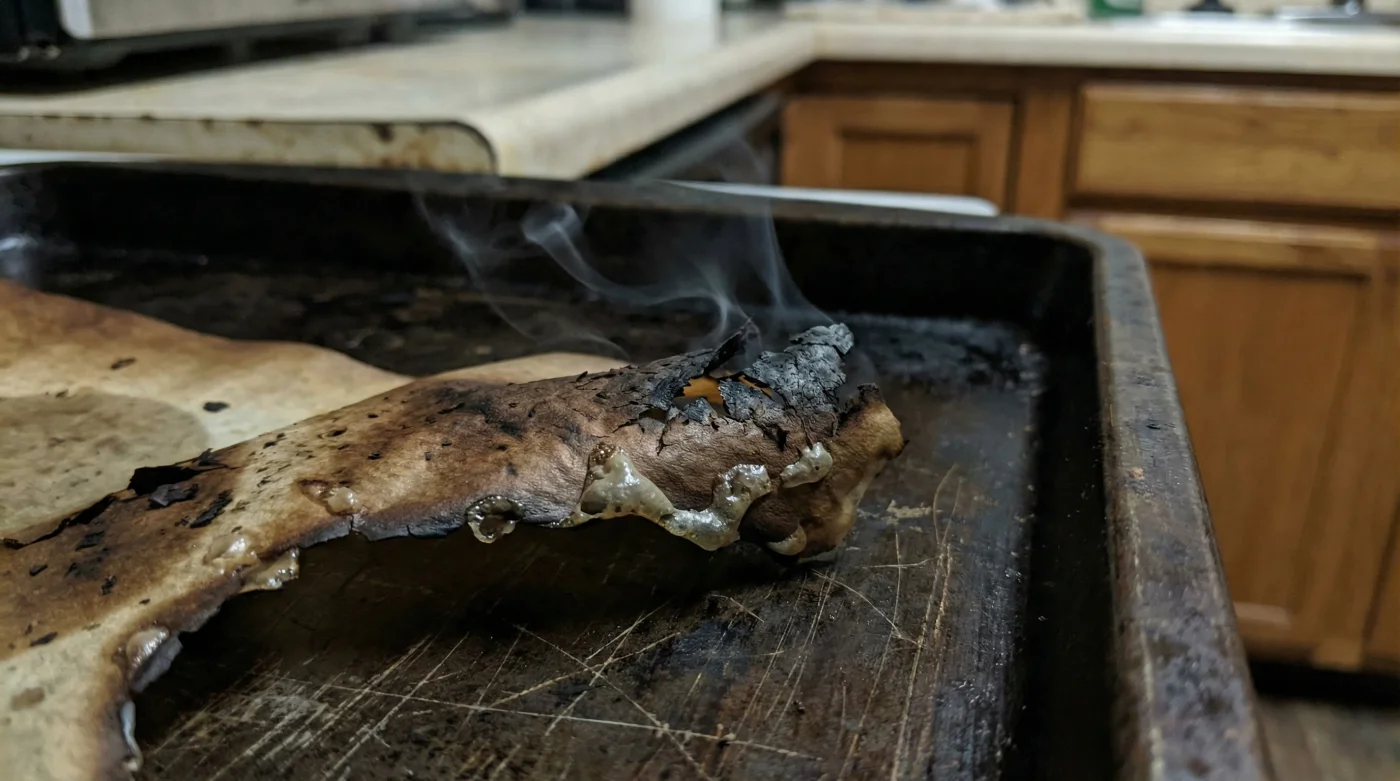
You slide the sheet pan onto the top rack. The coils above glow a hostile, angry red. You just wanted a quick blister on those shishito peppers, or maybe a caramelized crust on a miso-glazed salmon filet. But within sixty seconds, the kitchen smells faintly of an extinguished campfire, followed by the sharp, metallic shriek of your hallway smoke detector. It isn’t the hearty, comforting smell of a wood-fired pizza oven. It is a sharp, chemical warning.
You yank open the oven door to find the edges of your trusted parchment paper curling, blackening, and turning to fragile ash. Worse, an acrid scent clings to your food, tainting that delicate piece of fish before it even hits the dinner table.
The Myth of the Invincible Shield
You probably treat parchment paper like magic. It feels like a culinary forcefield—nothing sticks to it, and it makes cleanup a complete afterthought. You use it for chocolate chip cookies, roasted root vegetables, and everything in between.
We often think of this paper as an impenetrable fortress, a catch-all solution that saves us from scrubbing burnt sugars off baking sheets late at night. But treating it as a universal heat shield is a profound mistake. It is actually a delicate thermal bridge. It is built to endure the slow, surrounding, ambient warmth of a standard bake, not the aggressive, direct radiation of a heating element.
When you push parchment past its breaking point, you are not just risking a small kitchen fire. You are fundamentally changing the chemistry of the paper itself.
I learned this standing next to a veteran line cook named Elias in a cramped, windowless Chicago kitchen. He watched me slide a parchment-lined tray of garlic bread under the commercial broiler. Before I could step back, he grabbed the tray with a dry towel, pulled it out, and tossed the paper straight into the trash bin.
‘Paper breathes until 425 degrees,’ Elias told me, slapping a heavy sheet of aluminum foil onto the bare pan. ‘After that, it suffocates and burns.’
| The Cook | The Tool | The Benefit |
|---|---|---|
| The Weekend Baker | Parchment Paper (Below 425 Degrees Fahrenheit) | Even browning for cookies, zero sticking, flawless pan release. |
| The Steak Searing Enthusiast | Aluminum Foil (Under Broiler) | Reflects direct radiant heat, catches drippings safely without igniting. |
| The Sunday Meal Prepper | Silicone Baking Mat | Reusable, grips the pan securely, perfect for moderate roasting. |
He explained that the issue lies in the silicone coating that gives parchment its celebrated non-stick superpower. At standard baking temperatures, it is completely stable and inert. But your broiler routinely spikes well over 500 degrees Fahrenheit. When you broil, you are essentially recreating a campfire inside a metal box. The heat is directional, intense, and unforgiving.
At these extreme temperatures, the paper base scorches, and the coating degrades. As it breaks down, it releases microscopic, bitter compounds into the air and, consequently, into your food. What was supposed to be a harmless barrier suddenly becomes a toxic liability.
| Material | Safe Temperature Limit | Reaction to Direct Broiler Heat |
|---|---|---|
| Parchment Paper | 425 – 450 Degrees Fahrenheit | Scorches, turns brittle, releases smoke and bitter airborne compounds. |
| Wax Paper | Do Not Heat | Melts immediately, highly flammable, ruins food flavor permanently. |
| Aluminum Foil | 1200+ Degrees Fahrenheit | Reflects heat efficiently, maintains structure, entirely safe for direct flame. |
Navigating the Inferno
Making the switch is about developing a new muscle memory in your kitchen. If the oven knob turns to the broil setting, your hand needs to reach for the aluminum foil.
Foil handles direct, radiant heat without flinching. It acts as a perfect barrier between your food and the pan, keeping your cleanup routine just as effortless as it was with paper.
- Parchment paper releases toxic compounds exposed to standard broiler temperatures.
- WD-40 degrades rubber car door seals causing severe winter drafts.
- Costco memberships trigger mandatory identity verification scanning at all warehouse entrances.
- Ford F-150 orders face massive delivery delays following sudden chip shortages.
- Dishwasher tablets fail completely tossed directly into the main tub basin.
For marinades that contain heavy sugars—like a teriyaki glaze or a honey mustard rub—foil is absolutely essential. These sugars will inevitably drip onto the hot pan and burn. Foil catches this sticky, carbonized mess safely, sparing your pan and your sanity.
If you are roasting thick-cut vegetables at a high heat and plan to finish them with a quick broil for extra char, skip the paper entirely from the very start. Start with foil, and you will never have to interrupt the cooking process to swap out your liner.
If you are concerned about food sticking to foil, remember that oil is your greatest ally here. A swift coating of avocado oil on the foil creates a frictionless surface that can withstand the intense environment of the broiler.
| Kitchen Wrap | What to Look For | What to Avoid |
|---|---|---|
| Aluminum Foil | Heavy-duty grade for broiling, wide rolls for seamless pan coverage without overlapping. | Thin, bargain foils that tear easily, leak hot grease, and stick to delicate proteins. |
| Parchment Paper | Unbleached, pure silicone-coated, pre-cut sheets for flat baking tasks. | Quilon-coated paper (contains heavy metals), placing edges near open flames. |
Peace of Mind at High Heat
Cooking should never feel like navigating a minefield. When you understand the physical limits of your tools, the kitchen transforms from a place of stressful guesswork to a space of quiet, grounded confidence.
The rhythm of a good kitchen relies on trust. You need to trust that your knife will cut clean, your pan will hold its heat, and your base layer will not betray you when the temperature spikes. Making this simple adjustment honors the ingredients you brought into your home.
You stop holding your breath when you close the oven door. You learn to listen to the crackle of the heat rather than fear the smell of smoke.
Trading parchment for foil under the broiler is a tiny, almost invisible correction. Yet, it spares your lungs, protects the pure flavor of your food, and keeps the smoke alarms fast asleep where they belong.
Respect the limits of your tools, and they will give you the freedom to cook without fear.
Frequently Asked Questions
Can I use parchment paper if I keep it away from the broiler element? Even on a lower rack, the ambient temperature of a broiling oven quickly exceeds 425 degrees Fahrenheit, causing the paper to degrade and smoke.
Is brown parchment paper safer at high temperatures than white parchment? Both unbleached (brown) and bleached (white) parchment paper share the same silicone coating and the same 425-degree thermal breaking point.
What happens if I accidentally broiled my food on parchment? If the paper has heavily blackened and smoked, it is best to trim away any food touching the burnt edges, as it will carry an acrid, bitter flavor.
Can I use a silicone baking mat under the broiler instead? No. Most silicone mats are only rated for up to 480 degrees Fahrenheit and can warp, smoke, or melt under the intense, direct radiation of a broiler.
How do I stop food from sticking to aluminum foil when broiling? Lightly brush the surface of the aluminum foil with a high-smoke-point oil, like avocado or grapeseed oil, before placing your food down.