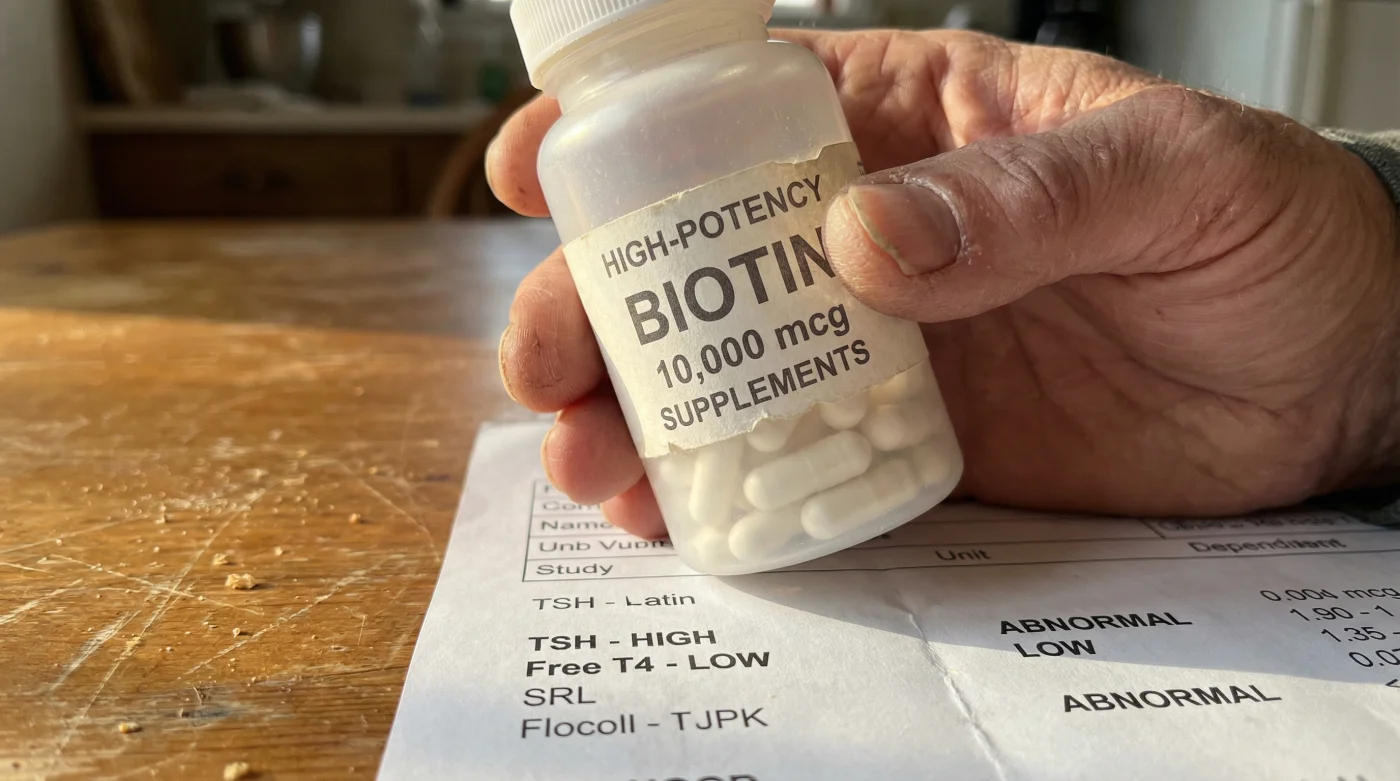
The crisp crinkle of the medical exam table paper echoes in the small room. You sit there, cold air brushing against your bare arms, listening to the faint hum of a fluorescent bulb overhead. When your doctor finally opens the heavy wooden door, she carries a printed chart and a concerning frown. Your routine bloodwork is back, and according to the numbers, your thyroid is in a state of absolute chaos. Your heart races. You feel fine. In fact, lately, you feel great. Your morning routine is dialed in, your energy is steady, and your hair has never looked thicker. How could your internal engine be failing without a single warning sign? The answer might not be a malfunctioning organ. The culprit might be sitting in a harmless-looking pink gummy bear on your bathroom counter.
The Illusion of the Harmless Beauty Supplement
It is incredibly common to assume that over-the-counter beauty vitamins carry zero internal consequences. You swallow a daily biotin capsule to strengthen brittle nails and add a bit of shine to your hair, trusting the old adage that whatever your body does not need will simply wash away. You make a mistake when you assume these supplements stay isolated to your vanity. High-dose vitamins act like heavy static on a radio frequency when it comes to modern medical testing.
Think of lab testing as an intricate lock-and-key mechanism. Your doctor is trying to get a clear read on your internal rhythm, but the massive influx of biotin throws sand directly into the delicate gears of the lab machinery. You end up with a terrifying, false diagnosis.
| Target Audience | Common Supplement Used | The Unintended Consequence |
|---|---|---|
| Hair & Nail Groomers | High-dose Biotin (5,000-10,000 mcg) | Mimics severe hyperthyroidism (Graves’ Disease). |
| General Wellness Seekers | B-Complex Vitamins | Falsely elevated T4 and falsely suppressed TSH. |
| Prenatal Patients | Prenatal Multivitamins | Obscured early-stage thyroid shifts during pregnancy. |
A few years ago, I sat in a brightly lit laboratory with a veteran clinical pathologist. He pointed to a patient’s chart that showed off-the-charts hyperthyroidism. The numbers suggested a person on the verge of a medical emergency. Yet, the patient had zero physical symptoms. No tremors, no rapid heartbeat, no sudden weight loss. The pathologist sighed, pushed his glasses up his nose, and said, ‘Call her and ask what hair vitamins she takes.’ He knew what most patients do not: they were diagnosing a vitamin overload, not a thyroid crisis. This is a crucial mistake that leads to unnecessary anxiety, repeat blood draws, and sometimes, inappropriate medication.
The Microscopic Velcro Effect
To avoid this trap, you have to understand why the lab gets confused. Many modern testing facilities use a chemical reaction called a biotin-streptavidin immunoassay. It acts like microscopic Velcro, grabbing onto the specific thyroid hormones in your blood sample so the machines can count them accurately.
When you consume thousands of micrograms of beauty vitamins, your bloodstream becomes flooded with free-floating biotin. During the blood test, this loose biotin rushes in and sticks to the Velcro first, completely blocking the actual hormones from attaching. The lab equipment is effectively blinded. It registers a false high for certain hormones like T4 and T3, and a false low for TSH (Thyroid Stimulating Hormone).
| Hormone Tested | Biotin Interference Result | False Diagnosis Triggered |
|---|---|---|
| TSH (Thyroid Stimulating Hormone) | Falsely Low (Suppressed) | Hyperthyroidism |
| Free T4 (Thyroxine) | Falsely High (Elevated) | Graves’ Disease / Toxic Nodules |
| Free T3 (Triiodothyronine) | Falsely High (Elevated) | Hyperthyroidism |
Clearing the Canvas Before You Test
Fixing this issue does not require you to permanently abandon your beauty routine. It simply requires mindful timing and treating your bloodwork like a blank canvas that needs to be prepped. The most common mistake people make is taking their morning handful of vitamins right before heading to the phlebotomist.
- Salicylic acid cleansers cause severe hyperpigmentation paired with physical exfoliating scrubs.
- Magic Erasers strip protective polyurethane finishes completely off hardwood living floors.
- Medicare Part D beneficiaries incur lifetime penalty fees missing this enrollment deadline.
- Biotin supplements falsely trigger catastrophic thyroid disease results during routine bloodwork.
- Ring Doorbell motion sensors miss package thefts ignoring this specific placement.
When you sit down in the doctor’s office, overcommunicate. Tell your provider exactly what is in your medicine cabinet. Bring the bottles if you have to. A label that says ‘Hair, Skin, and Nails Support’ might not prominently display the word biotin on the front, but flip it over, and you will often find 10,000 micrograms packed into a single serving. That is more than 300 times your adequate daily intake.
| Quality Checklist | What to Look For | What to Avoid |
|---|---|---|
| Supplement Labels | Alternative names like Vitamin B7 or Vitamin H. | Assuming ‘natural blends’ lack high-dose biotin. |
| Pre-Test Routine | A 72-hour hard pause on all complex multivitamins. | Taking morning gummies right before a fasting lab. |
| Doctor Communication | Explicitly listing your cosmetic supplements. | Only mentioning prescription medications. |
Reclaiming Your Peace of Mind
Your daily routine should bring you confidence, not accidental panic. When you understand the silent dialogue between the vitamins you swallow and the lab equipment analyzing your blood, you take control of your healthcare. You protect yourself from the emotional shock of a catastrophic diagnosis that simply does not exist.
By intentionally clearing your system before a test, you ensure that your doctor is looking at a true reflection of your health. You remove the static. You allow your actual internal rhythm to be heard, clear and unobstructed. It is a small, empowering adjustment to your schedule that preserves both your physical vitality and your peace of mind.
A true picture of your health requires a clear lens; do not let a beauty routine smudge the glass right before your doctor looks through it.
Frequently Asked Questions
Does biotin permanently damage my thyroid?
No. Biotin only interferes with the laboratory testing equipment, not your actual thyroid gland. Your organ functions perfectly fine, but the test results are artificially skewed.How long do I need to stop taking biotin before a blood test?
You should pause all biotin and B-complex supplements for at least 72 hours prior to your lab work to ensure the excess vitamin has left your bloodstream.Is biotin hidden in other supplements?
Yes. It is frequently labeled as Vitamin B7 or Vitamin H, and is commonly found in prenatal vitamins, energy drinks, and generic multivitamins.Will a fasting blood test prevent this interference?
Fasting only stops recent food intake from affecting glucose or lipid panels; it does not clear high-dose biotin that has accumulated in your blood over days.Should I stop taking biotin altogether?
There is no need to stop completely if you find it beneficial for your cosmetic goals. Just manage the timing strictly around your medical appointments.