You pull your favorite cotton t-shirts from the drum. They should smell like crisp morning air, but instead, a heavy, sour scent hits your nose—like a damp towel left in a gym bag over a long weekend. You pour in more detergent next time, hoping to overpower the funk, only to find the clothes smell even worse.
We are taught that washing machines are self-cleaning by nature. Water goes in, soap spins around, and dirt goes out. But front-load washers operate on a completely different physical principle than their top-loading ancestors. They rely on watertight rubber seals to keep the water off your floor, creating an environment that behaves more like a terrarium than a cleaning appliance. Unlike the loose metal lids of top-loaders that passively vent steam, a front-loader locks down like a submarine hatch. The exact engineering that prevents your laundry room from flooding is the same engineering that traps the heat of the wash cycle inside.
When you swing that heavy glass door shut right after pulling out your damp jeans, you are trapping a pint of warm moisture inside. In the dark, humid ecosystem of the rubber gasket, you aren’t just storing your washer. You are actively cultivating a microscopic garden.
The Terrarium Effect
Think of your washing machine not as a metal box, but as a lung. It needs to exhale after it works. For years, the standard advice has been to shut appliance doors to keep the laundry room looking tidy, a habit passed down from an era of entirely different machines. But applying that logic to a modern high-efficiency front-loader is like trapping a sweaty runner in a closet immediately after a marathon. The heat has nowhere to go, and the dampness settles into every crevice.
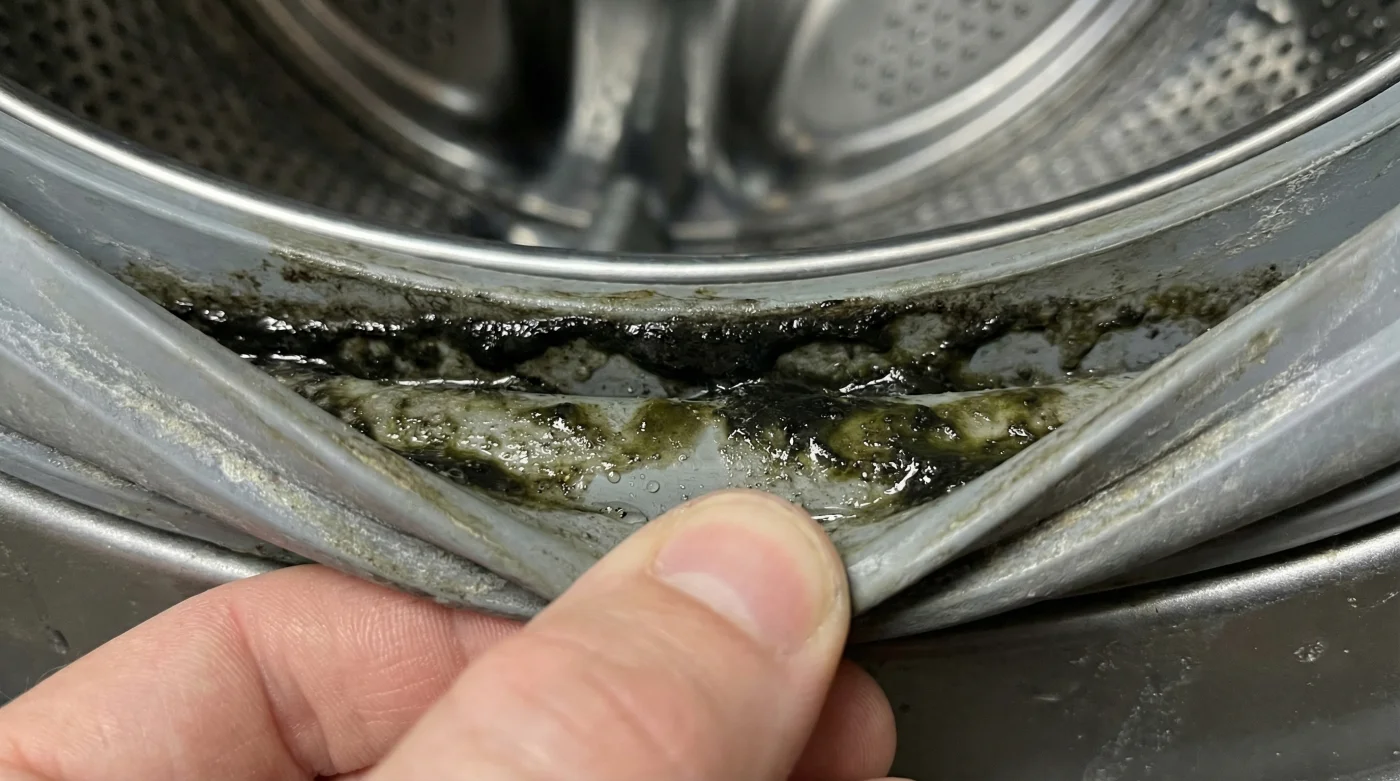
The perspective shift happens when you realize the rubber gasket isn’t just a barrier; it’s a collection tray. This thick ring of synthetic rubber holds microscopic pools of standing water, dead skin cells, and detergent residue. Leaving the door wide open transforms this flaw into a major advantage. By simply allowing room-temperature air to circulate, you break the cycle of humidity and starve the colony before it even takes root.
Sarah Jenkins, a 42-year-old appliance repair technician in Seattle, sees this precise failure every Tuesday. “People call me in a panic because their towels smell like pond water,” she explains while pulling back the folds of a customer’s washer gasket to reveal a thick black sludge. “They buy expensive tub-cleaning tablets, but they forget that mold only needs dark, still moisture to thrive. I tell them to treat the washer door like a wet umbrella. You would never fold it up and put it in the closet while it’s still raining. Yet, people do exactly that with a steel drum full of hot vapor. The fix isn’t chemistry; it’s basic airflow.”
Adapting Your Airflow Strategy
- Front-load washing machines develop severe mold colonies skipping this crucial post-cycle habit.
- Surge protectors secretly stop defending home electronics after absorbing this specific capacity.
- Silica gel packets solve major household moisture problems when rescued from new shoe boxes.
- Electric toothbrush motors burn out prematurely skipping this simple post-brushing rinse routine.
- Stainless steel pans become non-stick permanently mastering this simple pre-heating water test.
For the busy family running back-to-back loads of soccer uniforms, grass-stained jeans, and heavy cotton bath towels, moisture never really gets a chance to evaporate naturally. Your machine is constantly working in a high-humidity state. Your strategy needs to be a bit more direct. Keep a dry microfiber cloth folded right on top of the machine. The moment the final load finishes, do a quick ten-second wipe inside the lower rubber folds before propping the door open. This physically removes the puddles that mold spores desperately need to survive the night.
If your washer is tucked into a narrow hallway closet, leaving the door wide open might block traffic entirely. Fortunately, a two-inch crack is enough to let the machine breathe. Many modern front-loaders have a magnetic latch specifically designed to hold the door slightly ajar without swinging out into the room. If yours does not, a small rolled-up washcloth wedged in the hinge works perfectly.
The Post-Cycle Reset
Preventing the sour smell doesn’t require a weekend of scrubbing. It simply requires a mindful shift at the exact moment you transition clothes from the washer to the dryer. Think of these steps as the cool-down stretch for your machine.
Instead of rushing back to your day, take exactly ten seconds to perform this mechanical reset.
- Remove all wet garments immediately upon hearing the chime.
- Pull back the rubber lip of the door seal and inspect for lingering puddles.
- Swipe the inner gasket with a dedicated dry cloth to absorb standing water.
- Leave the washer door open at least a hand’s width to allow a cross-breeze.
- Pull the detergent dispenser drawer out halfway so it can dry alongside the drum.
Here is your tactical toolkit for lasting freshness: Keep one standard microfiber cloth explicitly for the gasket, draped over the edge of the machine so you never have to go looking for it. The time limit for this routine is exactly fifteen seconds post-cycle—do not overcomplicate it. The temperature logic is simple: room-temperature air neutralizes warm dampness. By opening the machine up to the ambient air of your house, the moisture evaporates harmlessly into the room rather than condensing onto the inner mechanics.
Reclaiming Your Peace of Mind
We spend a massive amount of energy trying to solve problems that we accidentally create. Buying heavily scented detergents and expensive chemical cleaners is just treating a symptom. The real cure is simply giving your tools the space they need to breathe.
By leaving that door slightly open, you are no longer fighting against nature in your laundry room. You transform a stressful, smelly chore into a reliable, invisible system. Your clothes come out smelling like exactly what they are—clean fabric, ready to be worn, free from the phantom scent of yesterday’s wash water. You regain the simple comfort of wrapping yourself in a fresh towel that smells like nothing at all, confident that your machine is working with you, not against you.
“Airflow is the only natural enemy of mildew; master the breeze and you will never scrub a rubber seal again.”
| Key Point | Detail | Added Value for the Reader |
|---|---|---|
| Door Shut Immediately | Traps warm, humid air inside the drum and gasket. | Cultivates severe mildew; ruins the smell of clean laundry. |
| Door Left Ajar | Allows residual moisture to slowly evaporate into the room. | Prevents odors; extends the lifespan of the rubber seal. |
| Wiping the Gasket | Physically removes standing water and lint from the lowest point. | Eliminates the breeding ground entirely; zero maintenance required later. |
Frequently Asked Questions
Will leaving the door open wear out the hinges? No, modern front-load washers are designed to support the weight of an open door indefinitely.
What if my laundry room is too humid to dry the machine? If the room itself feels like a greenhouse, run a small fan or a dehumidifier for an hour after washing to pull the moisture out.
Can I use bleach to clean the mold if it is already there? Bleach can degrade the synthetic rubber over time. White vinegar applied with a soft cloth is much safer for the gasket material.
Why does the detergent drawer smell bad too? Liquid fabric softeners and detergents leave a sticky film. Pulling the drawer out allows it to dry just like the main drum.
Is it normal for the rubber seal to look slightly stained? Light gray discoloration is normal aging, but fuzzy or slick black patches require immediate physical removal.