You stand under the harsh fluorescent glare of your bathroom mirror, tapping a frosted glass bottle against your palm. The morning routine is a familiar ritual: a pump of that velvety, high-end facial primer smoothing over your cheeks, followed by a careful layer of liquid foundation. The beauty counter promised this exact sequence would erase the years, blurring imperfections into a seamless finish.
For the first twenty minutes, the illusion holds. Your skin feels impossibly soft, gliding under your fingertips like spun silk. You walk out the door feeling protected, armed with a barrier that supposedly locks your makeup in place until dinnertime.
But catch your reflection in the rearview mirror by lunch, and a different story unfolds. The makeup hasn’t just faded; it has actively turned against you. What started as a radiant glow now sits heavy in the microscopic creases around your eyes and mouth, mapping out fine lines you didn’t even know you had.
The beauty industry sold you a perfectly packaged lie. That slippery, protective layer of silicone primer isn’t acting as a magnet for your foundation. It is acting as a repellent, pushing the pigment away from your skin and straight into the very crevices you were trying to hide.
The Physics of a Fractured Canvas
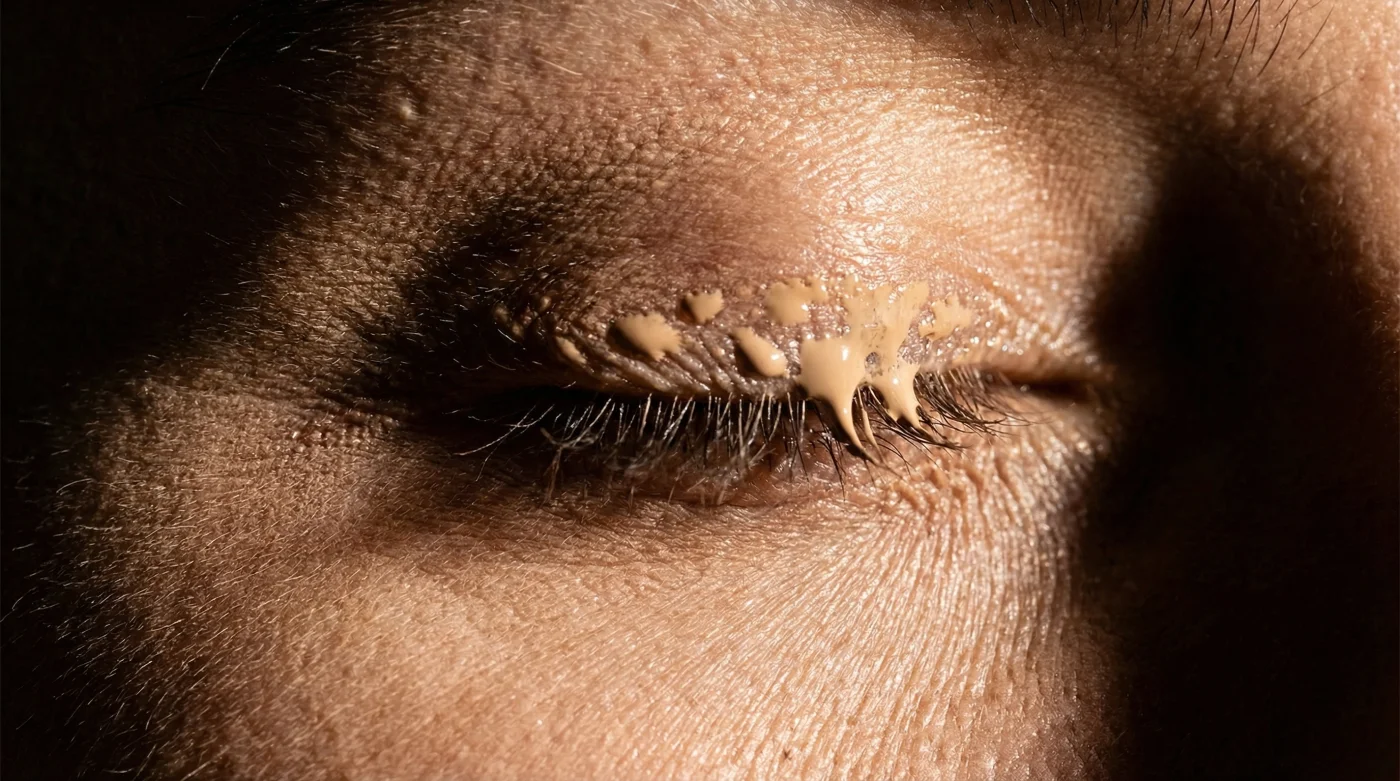
Think about pouring a glass of water onto a freshly waxed car hood. The liquid doesn’t absorb or lay flat; it violently beads up, rolling away from the slick surface to collect in the nearest groove. This is exactly what happens when you spread a water-based liquid foundation over a silicone-heavy primer.
You are essentially painting watercolors over plastic. Silicone molecules are notoriously large and hydrophobic, meaning they aggressively repel moisture. Imagine the silicone layer as a perfectly smooth pane of glass. When your water-based foundation hits that invisible wall, it panics. Deprived of the natural warmth and porous grip of your skin, the foundation pigment detaches from its hydrating liquid carrier.
Left with nowhere else to go, those dry color particles slide across your face and pool inside your fine lines. The body heat from your face acts like a catalyst, speeding up this chemical divorce. By two in the afternoon, this microscopic migration creates a cracked, heavy texture that accelerates visual aging. The very step designed to create a youthful blur is the exact mechanism aging your complexion.
The surprising truth is that skipping the primer entirely often yields a much younger, more resilient finish. Your skin’s natural lipid barrier is the best canvas you already own, provided it is properly hydrated. You want a base that breathes like cotton, not one that seals like a rain slicker.
Sarah Jenkins, a forty-two-year-old bridal makeup artist based in Chicago, built her entire career by throwing out the rulebook at the beauty counter. She frequently watches brides sit in her chair holding expensive, silicone-based blurring creams they swear by, terrified to walk down the aisle without them. “They come in wanting a flawless base,” Sarah says, “but they pair a dimethicone primer with a botanical water foundation. Within an hour under flash photography, the face looks like a dry riverbed. I immediately wash it off, press a simple moisturizer into the skin, and let the foundation actually touch the face. The skin instantly looks ten years younger because it can finally breathe.”
Reading the Labels: The Ingredient Matchmaker
You don’t necessarily have to throw away your entire vanity collection, but you do need to audit it. The key to a finish that moves with your facial expressions rather than cracking against them is simple chemistry.
For the Hydration Seeker
If your skin leans dry, you likely gravitate toward foundations boasting hyaluronic acid, aloe, or botanical waters. These formulas crave absorption. Pair them with a water-based gripping primer or, better yet, a rich ceramide cream. Let the moisturizer sink in for five full minutes before opening your makeup drawer.
When you apply the foundation, it will drink the moisture, fusing seamlessly with your skin rather than fighting a silicone barrier. This creates a plump, living finish that refuses to settle into crow’s feet or laugh lines.
For the Oil-Prone Minimalist
- Robot vacuums ruin hardwood floors dragging undetected microscopic sand particles.
- Ceramic brake pads destroy factory rotors skipping this specific bedding.
- Garlic cloves lose potent flavor completely dropped into hot oil.
- Severance agreements forfeit future unemployment benefits containing this standard paragraph.
- Liquid foundation accelerates visual aging layered over silicone facial primers.
Check the first five ingredients on the back of your bottle. If you see words ending in cone, methicone, or siloxane on both products, they will play nicely together. Mismatching them is the silent saboteur of your morning routine.
The Bare-Skin Blueprint
Fixing this daily friction doesn’t require buying more products; it requires a subtraction of variables. By paring down the layers, you allow the chemistry of your makeup to work as intended. Approach your vanity with a lighter touch and a deliberate strategy.
- Check the base element: Look at the first ingredient after water on your foundation label. If it is cyclopentasiloxane, it is silicone-based. If it is glycerin, it is water-based.
- The bare-skin test: Try applying your liquid foundation directly over a fully dried moisturizer for three days to observe how the pigment behaves naturally.
- Spot-treat with silicone: If you have severe pores on your nose, tap a tiny amount of silicone primer strictly on that area, avoiding line-prone zones.
- Press, never wipe: Use a damp sponge to firmly press the foundation into the skin to avoid micro-tears in the lipid barrier.
The Tactical Toolkit involves keeping your application window tight. Give your moisturizer exactly three minutes to settle until the skin feels slightly tacky, not wet. If you touch your cheek and it feels like the sticky side of a light adhesive tape, you are ready.
If your fingers glide without resistance, you are risking premature separation of the foundation pigment. Use less than half a pump of foundation to start. You can always build coverage, but you cannot undo a heavy-handed application once it settles into a smile line.
Reclaiming Your Reflection
We are conditioned to believe that more layers equate to better protection, that flawless skin is built by stacking expensive barriers between ourselves and the world. But the reality of beauty is far more forgiving.
When you stop trying to spackle your face with incompatible chemistry, a quiet relief washes over your morning routine. You stop checking the mirror at noon with dread, bracing yourself for the inevitable creasing and cracking. You realize your skin was never the problem; the rigid rules of the beauty counter were.
By understanding the simple friction between silicone and water, you liberate yourself from the heavy, aging masks of the past. You allow your liquid foundation to melt into the natural warmth of your face, moving as you laugh, speak, and live.
True radiance doesn’t come from a perfectly sealed surface. It comes from skin that is finally allowed to act like skin, breathing effortlessly through the day.
“The secret to a youthful complexion isn’t found in a thicker primer, but in the harmonious chemistry between your skin and your foundation.”
| Primer Base | Foundation Base | Midday Result |
|---|---|---|
| Silicone Heavy | Water Based | Tragic pooling in fine lines; accelerated visual aging. |
| Water Based | Water Based | Seamless blending; moves organically with facial expressions. |
| Silicone Heavy | Silicone Based | Locked-in matte finish; best reserved for extreme oil control. |
Frequently Asked Questions
How do I know if my foundation is water-based? Look at the ingredient list. If water is the first ingredient and there are no words ending in -cone or -siloxane in the top five, it is water-based.
Can I skip primer entirely if I have mature skin? Absolutely. A rich, well-absorbed moisturizer often provides a better, more flexible base for mature skin than a stiff silicone primer.
Why does my makeup look flawless for an hour before separating? Silicone repels water slowly. The body heat from your face accelerates this repulsion, causing the water-based makeup to slide into crevices over time.
Is silicone bad for my skin? Not inherently. It forms a breathable barrier that locks in moisture, but that same barrier prevents water-based makeup from adhering properly.
What is the best way to apply water-based foundation? Press it into hydrated skin using a damp sponge. Avoid wiping or dragging motions, which disturb the lipid barrier beneath.