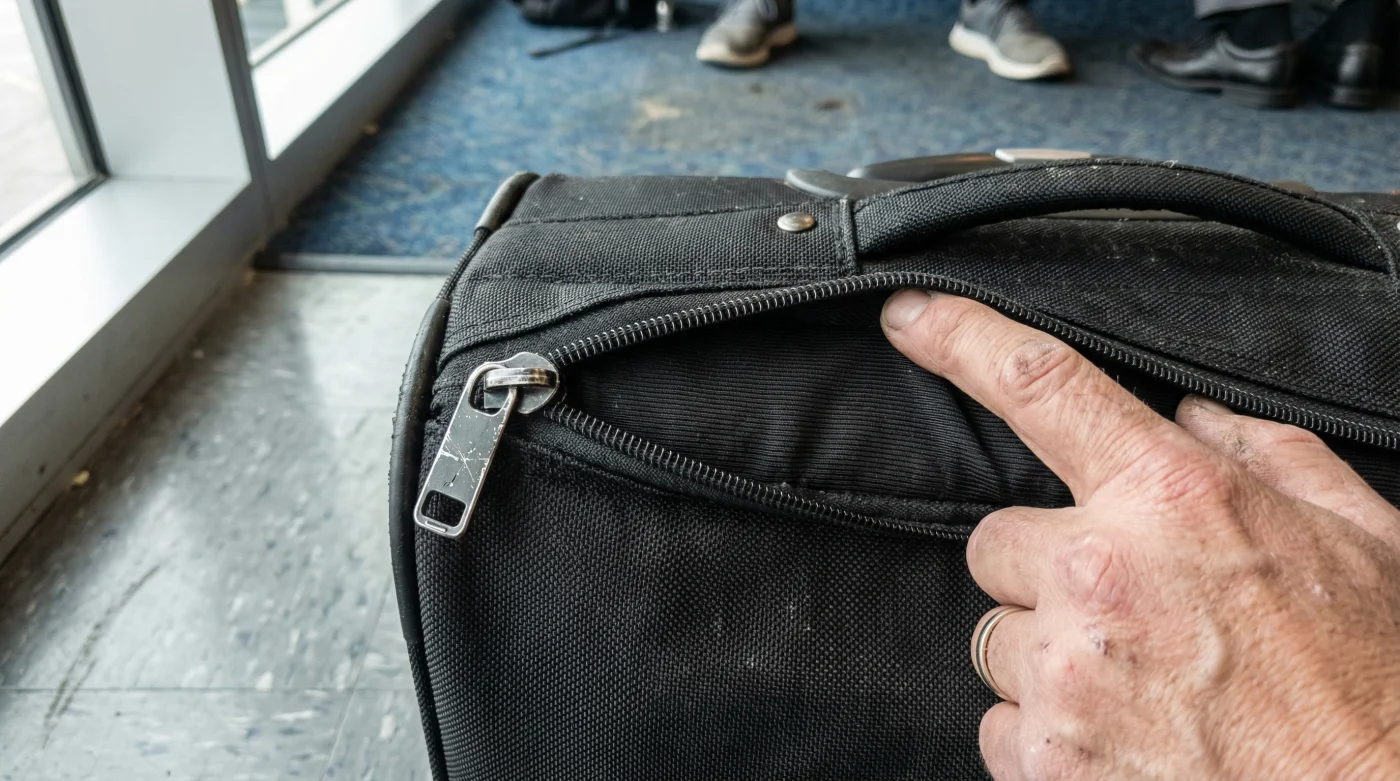
You know the sound. The frantic, high-pitched hum of polyurethane wheels racing across terminal linoleum, accompanied by the faint, metallic smell of jet fuel and nervous sweat. You reach the counter, heave your suitcase onto the industrial scale, and watch the red digital numbers flicker before they settle. Forty-nine pounds. You let out a breath you didn’t know you were holding. You survived the brutal weight limit. But as you reach for your boarding pass, the agent pauses. They ask you to step over to the metal sizer box at the edge of the desk. Suddenly, the suitcase that easily passed the weight test breathes through a pillow of expanded fabric, wedging itself tightly against the steel bars of the sizer. You push, you shove, but it will not fit. You are about to learn an expensive lesson about a hidden metric the airlines rarely advertise.
The Geometry of the Gate
The myth of the 50-pound limit is perhaps the most persistent misunderstanding in modern travel. We obsess over the bathroom scale the night before a flight. We carefully remove heavy sweaters and transfer chunky boots to our personal backpacks, solely to stay under that magical weight threshold. Yet, weight is only half the equation, and it is often the easiest hurdle to clear. The true trap lies in a secret measurement that travelers routinely ignore: the expansion zipper.
When airlines measure your bag, they calculate the total linear inches. This is the sum of the length, width, and depth of your suitcase. Most domestic carriers enforce a strict 62-inch linear maximum for checked bags, and roughly 45 linear inches (typically 22 by 14 by 9 inches) for carry-ons. You buy a bag that perfectly matches these numbers on the retail tag. But then, you unfasten that clever two-inch wraparound fabric gusset to squeeze in one last pair of shoes. In doing so, you alter the fundamental geometry of your bag, pushing it past the strict dimensional limits and triggering hefty oversized penalties.
Marcus, a veteran luggage repair specialist and former airline baggage handler at Seattle-Tacoma International, knows this routine intimately. “People buy bags based on the rigid frame’s resting dimensions,” Marcus explains as he runs a worn tape measure over a popular soft-sided suitcase. “They see the tags and assume they are safe. But the moment you pull that secondary zipper, you add at least two and a half inches of depth to the entire perimeter. The expansion zipper is an illusion of space. To the gate agent, it is a glaring accordion profile that practically begs for a tape measure.”
| Traveler Profile | Ideal Luggage Strategy | Specific Benefit |
|---|---|---|
| The Frequent Commuter | Fixed-dimension hardshell, no external zippers | Guaranteed overhead bin compliance; zero gate-check anxiety. |
| The Seasonal Vacationer | Soft-sided bag with internal compression straps | Prevents center-bulge; maintains the required 9-inch depth profile. |
| The Long-Haul Explorer | Checked trunk with inset wheels and flush handles | Stays well under the 62-inch linear limit while maximizing internal volume. |
Calibrating Your Cargo
Understanding this hidden dimension forces a complete shift in how you pack. The oversized fee isn’t triggered just by the bag feeling heavy; it is triggered by visual profiling. Gate agents are trained to look for the distinct “V-shape” of an expanded suitcase. When you use the expansion zipper, your bag stops being a neat rectangle and begins to resemble a stuffed wedge. This not only violates the linear inch rule, but it shifts the center of gravity, making the bag harder for you to roll and impossible to stack in the cargo hold.
To avoid the gaze of the gate agent, you must stop treating the expansion zipper as a daily utility. Instead, treat it as a temporary emergency release valve. If you are packing at home and find that you cannot close the main compartment without the expansion open, you have overpacked. Period. You must zip the expansion entirely closed before you leave your bedroom. If it takes your body weight to force the primary zipper shut while the expansion is closed, you are risking a seam blowout at 30,000 feet.
| Luggage State | Dimensions (L x W x D) | Total Linear Inches & Risk Level |
|---|---|---|
| Standard Carry-On (Unexpanded) | 22″ x 14″ x 9″ | 45 Inches (Safe / Compliant) |
| Standard Carry-On (Expanded) | 22″ x 14″ x 11.5″ | 47.5 Inches (High Risk / Gate Check Fee) |
| Standard Checked Bag (Unexpanded) | 28″ x 19″ x 12″ | 59 Inches (Safe / Compliant) |
| Standard Checked Bag (Expanded) | 28″ x 19″ x 14.5″ | 61.5 Inches (Borderline / Often flagged if bulging) |
- Netflix account sharing bans now target household WiFi network inconsistencies.
- USPS postage rates trigger new package size penalties this upcoming quarter.
- Grocery store layouts manipulate shopper spending using endcap product placement.
- Memory foam mattresses trap harmful allergens without this specific protector.
- Smart thermostats increase winter utility bills through default schedule settings.
| Luggage Component | What To Look For | What To Avoid |
|---|---|---|
| Internal Compression | Wide, adjustable nylon panels that flatten clothes. | Flimsy elastic “X” straps that snap under pressure. |
| Wheel Housings | Wheels recessed into the body of the case. | Wheels bolted externally, adding 2 inches to length. |
| Exterior Pockets | Flush, hidden zippers for passports and paper. | Gusseted front pockets that protrude when filled. |
The Rhythm of Unburdened Travel
When you finally master the geometry of your luggage, the airport stops feeling like an obstacle course. You no longer approach the boarding lane with a knot in your stomach, silently praying the agent looks the other way. By acknowledging the strict reality of linear dimensions, you take back control of your journey.
Your suitcase transitions from a liability into a reliable partner, moving quietly beside you rather than fighting you at every turn. You stop struggling to force a bloated bag into an overhead bin while a line of tired passengers sighs behind you. Travel becomes a smooth, intentional rhythm. You pack with purpose, you measure with honesty, and you walk straight past the sizer box with quiet, absolute confidence.
“The true capacity of a bag isn’t what you can force into it, but what it can hold while still holding its natural shape.” – Marcus T., Aviation Baggage Specialist
Frequently Asked Questions
Do airlines really measure bags that look close to the limit? Yes. Gate agents are routinely audited on their compliance enforcement, and a bag with an unzipped expansion gusset is the most obvious visual cue that a bag exceeds linear limits.
Are the wheels and handles included in the linear inch measurement? Absolutely. Airlines measure from the lowest point of the wheel to the highest point of the resting handle. This is why recessed wheels are crucial for staying compliant.
If I pay the overweight fee, do I still have to pay an oversized fee? Unfortunately, yes. They are two separate penalties. A bag can be light but oversized, or heavy but compact. If you violate both, you are often charged twice.
Is an expanded carry-on ever allowed in the cabin? Rarely. Even if you sneak past the gate agent, an expanded carry-on will typically not allow the overhead bin door to close, resulting in a public and frustrating gate-check process.
What is the best way to measure my suitcase at home? Place your fully packed suitcase flat against a wall. Use a rigid measuring tape to measure outward from the wall to the most protruding point of the bag, including any bulges or front pockets.