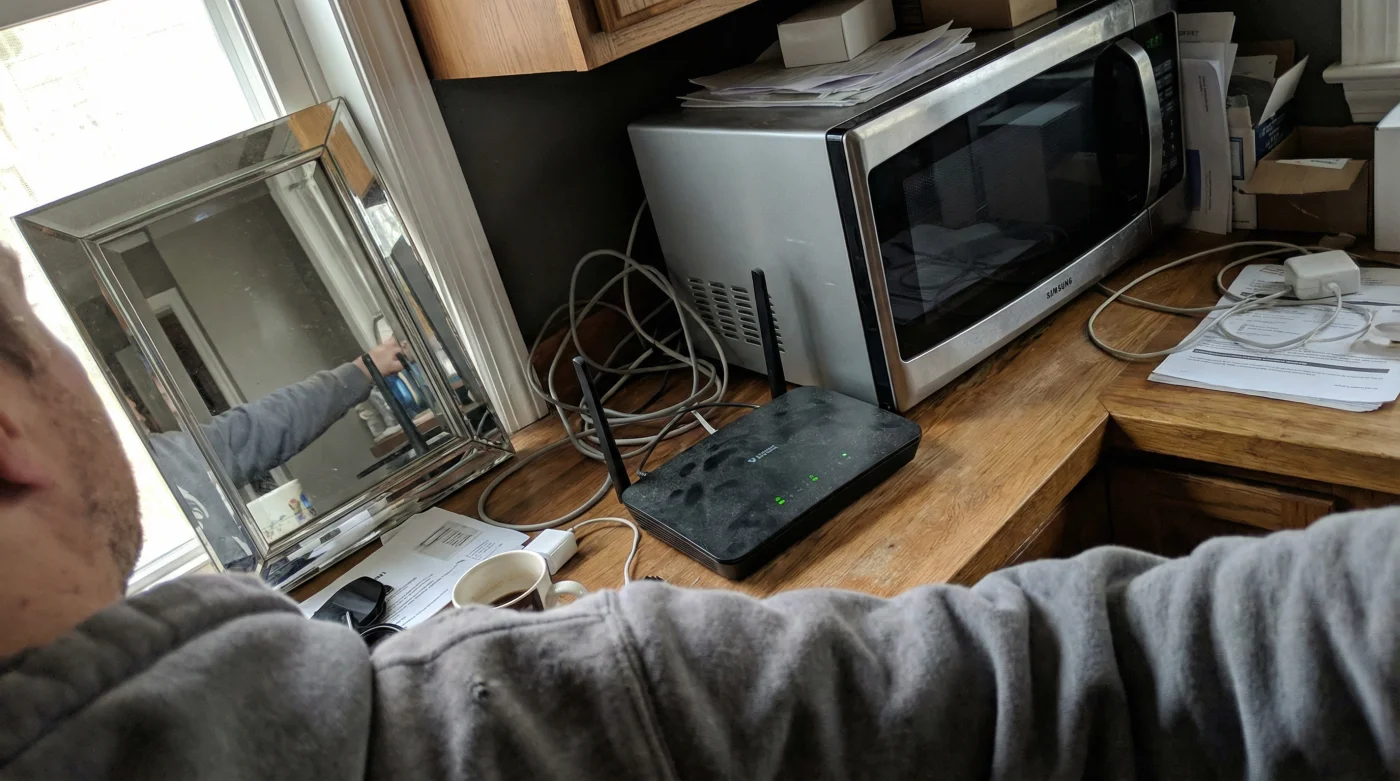
You sit back on the couch, exhausted after a long afternoon. You hear the low, rhythmic hum of the microwave spinning a leftover plate of lasagna in the kitchen. At the exact same moment, the movie you are trying to stream on your television stutters, freezes, and drops into a blurry mosaic of unreadable pixels. You let out a heavy sigh, mentally cursing your internet service provider and drafting an angry script to yell at customer service. But the truth is, the problem is not the invisible cables running under your street. The culprit is sitting right on your kitchen counter, and possibly hanging on your hallway wall.
The Flashlight in the Fog
We tend to think of internet speed as a municipal faucet. If the water pressure is low, we naturally blame the city reservoir. But a Wi-Fi router is less like plumbing and more like a flashlight trying to illuminate a completely dark house. When you place that router next to a microwave oven, or behind a heavy, antique hallway mirror, you are essentially pointing that flashlight directly into a thick, impenetrable fog. Your internet provider is actively sending the gigabit speed you pay for every month, but your home’s physical landscape is swallowing the signal whole. The assumption that your connection is strictly dependent on the company billing you is a pervasive myth. The reality is much more local.
I learned this vital lesson over a cup of black diner coffee with Marcus, a veteran broadband technician who has spent twenty years crawling through dusty American attics and cramped basements. Marcus has a unique habit of walking into a room and instantly spotting the invisible hurdles that ruin our daily digital lives. We were discussing why certain households constantly suffer from dropouts while their neighbors enjoy seamless connectivity.
“People treat routers like ugly bookends,” he told me, stirring his coffee with a worn spoon. “They desperately want to hide them. So, they shove them behind massive televisions, tuck them next to the refrigerator, or set them right beside the microwave. A microwave operates on the exact same 2.4 gigahertz frequency as most standard routers. When you turn it on to pop popcorn, it literally screams over the router’s quiet whisper.” He also pointed out a common interior design trap: thick mirrors. The metallic backing used to make a heavy mirror reflective acts as a literal shield. It catches your precious Wi-Fi signal and bounces it right back at the drywall.
| Household Profile | The Specific Benefit of Relocation |
|---|---|
| The Remote Worker | Eliminates sudden video call drops when someone else makes lunch. |
| The Dedicated Gamer | Stabilizes ping rates, stopping input lag during crucial matches. |
| The Evening Streamer | Eradicates the dreaded buffering wheel in the middle of a movie scene. |
The Physical Shift
Relocating your router takes about ten minutes of your time, but the payoff is beautifully immediate. First, unplug the unit from its dusty corner and seek out a central, elevated location in your home. Think of your router as a living room lamp. You want it resting high up on an open shelf, casting its signal downward and outward across the entire space.
Keep it out of the kitchen entirely. The kitchen is a hostile obstacle course of dense metal appliances, heavy water pipes, and frequency-jamming microwaves. Your signal breathes best in open air. When a router sits next to a stainless steel refrigerator, the massive casing and dense, circulating liquid absorb the radio waves like a sponge.
- Windshield wipers streak glass constantly without this simple rubbing alcohol technique.
- Cast iron skillets crack instantly washing them with cold tap water.
- Wi-Fi routers throttle internet speeds placed near these common household appliances.
- Google Chrome deletes standard ad blockers starting next Tuesday morning.
- Toyota hybrid models face indefinite production delays following sudden supplier bankruptcies.
| Obstruction Type | Scientific Logic & Interference Level |
|---|---|
| Microwave Ovens | Emits 2.4 GHz radiation, directly overlapping and drowning out standard Wi-Fi channels. High interference. |
| Thick Mirrors | Contains a metallic silver or aluminum backing that reflects electromagnetic waves back to the source. High interference. |
| Refrigerators | Large metal casing and dense, circulating liquid absorb and block signal passage. Moderate to High interference. |
| What to Look For (Good Placement) | What to Avoid (Bad Placement) |
|---|---|
| Elevated surfaces like open bookshelves. | Floor-level corners or behind heavy sofas. |
| Central locations bridging multiple rooms. | Kitchen countertops next to major appliances. |
| Direct line of sight to your main seating area. | Inside enclosed media cabinets or behind thick mirrors. |
Reclaiming Your Digital Rhythm
Moving your router is a remarkably tiny physical modification, yet it profoundly changes the entire texture of your evening. You stop bracing yourself for the dreadful buffering wheel during the climax of a film. You stop apologizing for dropping out of important remote meetings when someone in the house decides to heat up a snack.
By simply clearing the physical path for those invisible waves, you bridge the frustrating gap between what you pay for and what you actually experience. It brings a quiet, reliable predictability back to your home environment. You realize that you are no longer fighting invisible, frustrating ghosts in your living room. Instead, you are just sitting back, hitting play, and watching the screen come alive without a single stutter.
“Your router is trying to speak to your devices, but placing it next to a microwave is like asking it to whisper over a jet engine.” – Marcus, Veteran Broadband Technician
Frequently Asked Questions
Does moving the router a few feet really matter? Yes, escaping a direct obstruction like a mirror changes the immediate signal trajectory instantly.
Why is my 5GHz band also dropping? While microwaves mainly disrupt 2.4GHz, physical barriers like metal and mirror backings block all radio wave frequencies equally.
Can I put the router in a closet? No, doors and surrounding drywall absorb the signal, greatly reducing your coverage footprint across the house.
Does a router need to be near a window? No, windows can actually leak your signal outside; central indoor placement is far more effective for full-home coverage.
How high should my router sit? At least waist-high, preferably on a shelf five to six feet off the ground for optimal wave dispersion.